How to commission a handmade wooden box
Commissioning a bespoke handmade wooden box is very different from buying a ready-made box. A properly designed box should not only look beautiful; it should suit its purpose, protect or display its contents, and feel personal to the person who commissioned it.
I have worked as a self-employed furniture maker for more than 20 years, designing and making furniture and smaller pieces for individual clients. Over that time, I have learned that the most successful commissions begin with a clear conversation about what the client actually needs.
The timber, lining, hinges, finish and decorative details are all important, but they should follow the purpose of the box rather than dictate it.
Start by Deciding What the Box Is For
The first question I ask is simple: what is the purpose of the box?
Some boxes are intended to hold jewellery, watches, documents, photographs or personal keepsakes. Others are commissioned to protect and present one particular object.
If the box is being made for a specific item, I need to understand:
What the object is
Its exact size and shape
Whether it is delicate, valuable or easily marked
Whether it needs to be held securely
How often it will be removed from the box
Whether the box will be used for storage, presentation or both
These questions influence almost every part of the design.
A box made to store a collection of small objects may need removable trays or compartments. A box made for one valuable object may require a shaped interior that follows its form and prevents it from moving.
The outside dimensions cannot be decided properly until the internal requirements are understood.
Think About How the Contents Should Be Held
A bespoke box gives you the opportunity to design the interior around its contents rather than trying to make an object fit inside a standard box.
Depending on what is being stored, the interior could include:
Shaped recesses
Dividers
Removable trays
Fitted compartments
Padded sections
Supports that hold an object at a particular angle
A removable insert that allows the contents to be displayed
The object may need to fit firmly without being difficult to remove. It may also need protection from movement, dust or accidental contact with the timber.
Small adjustments can make a considerable difference. A finger recess, a ribbon lift or a carefully positioned support can make an object much easier and safer to remove.
This is one reason why it is useful to provide accurate dimensions, drawings or photographs during the early design stage. For some commissions, having the actual object available is the best way to ensure a precise fit.
Choose an Interior Lining That Suits the Object
The lining is not simply decorative. It can protect the contents, hold them securely and help present them properly when the box is opened.
Suede and faux suede can create a soft, refined interior. Other fabrics may be suitable depending on the purpose of the box and the effect the client wants to achieve.
Colour is also important. It may be chosen to complement the timber, match a company logo or create contrast with the object being displayed.
A pale object may stand out against a darker lining, while a stronger colour can make the interior feel more contemporary. The lining should support the overall design rather than look like an afterthought.
Consider the Colour and Character of the Timber
Clients do not need to know the name of every timber before contacting me. It is often enough to describe the general appearance they prefer.
For example, they may want:
A pale, clean-looking timber
A rich, dark timber
A strongly figured or decorative grain
A quiet, understated appearance
A traditional look
A contemporary look
Walnut has a rich, darker colour and can give a box a strong contemporary or luxurious feel. Sycamore is much paler and can be used to create contrast, either as the main timber or as a decorative detail.
Because wood is a natural material, every board is different. Colour and grain can vary even within the same species. I personally select the material for each commission, considering grain direction, figure and how the pieces will work together in the finished box.
Where appropriate, I can send samples to the client so they can see the timber and lining colours before making a final decision.
Decide Whether the Box Needs Personalisation
Personalisation can range from something very discreet to a major feature of the design.
This might include:
A name
A date
A message
A company logo
An engraved illustration
A decorative motif
A marquetry image or design
The best form of personalisation depends on the style of the box and the meaning behind the commission.
Engraving can be effective for lettering, dates and detailed designs. Marquetry creates an image or lettering by cutting and fitting contrasting veneers into the surface. It can become an integral part of the box rather than simply being added at the end.
Personalisation should be discussed early, particularly if it affects the lid, proportions or choice of timber.
A Bespoke Box Made for Silver Punk
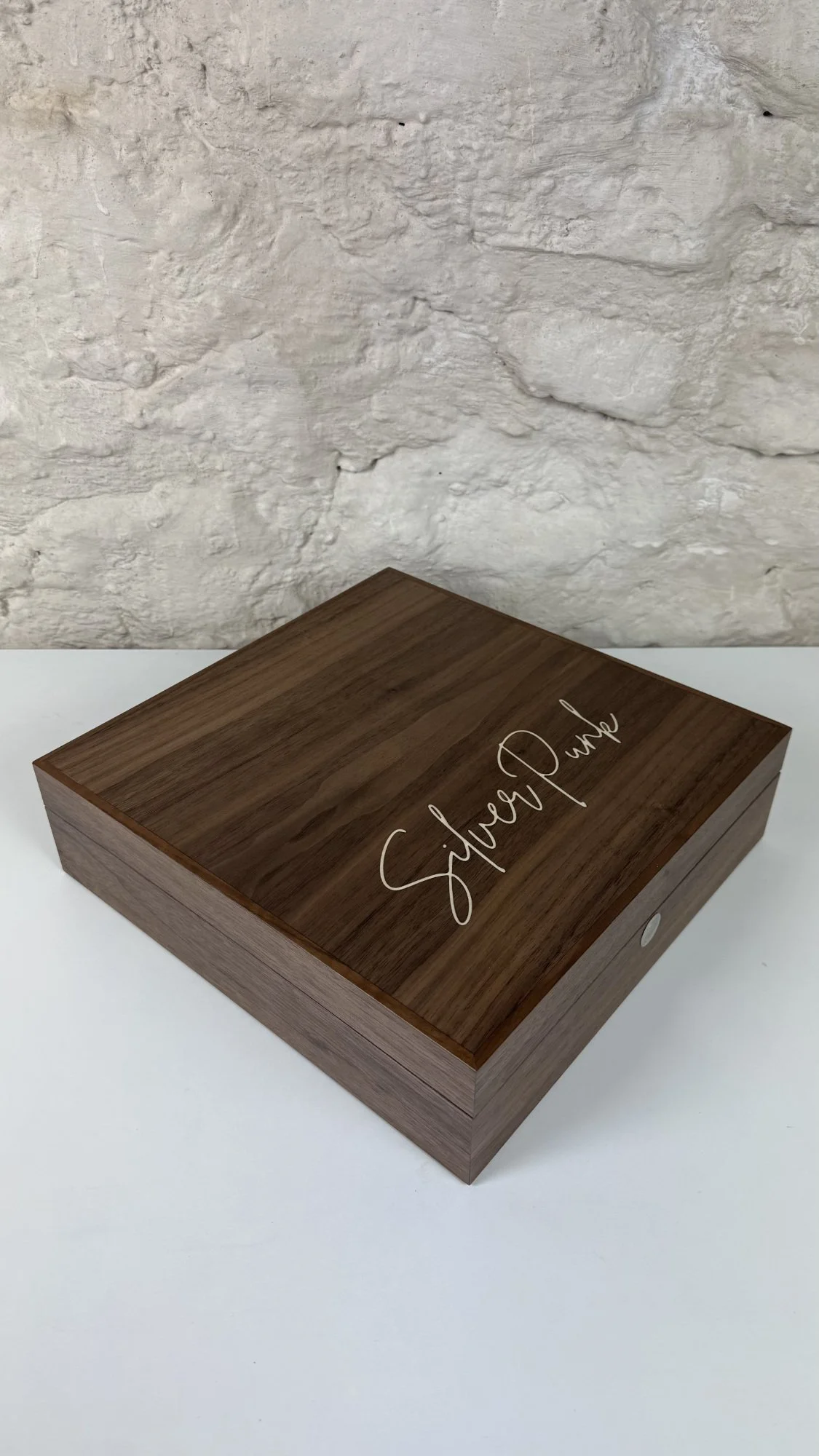
One memorable commission was for an artist whose business was called Silver Punk. He created solid silver artwork by casting silver into plaques and wanted a box for one of these pieces.
The box needed to perform two functions. It had to store the silver plaque securely, but it also had to present and display the artwork properly.
After discussing his requirements, we decided on a walnut box with a fitted red suede interior. The lining held the plaque firmly, while the red connected visually with the colours used in his business identity.
He also wanted the lid to remain securely closed, so the box was fitted with a button latch.
His Silver Punk logo was based on handwritten signature-style lettering. I reproduced it in pale sycamore marquetry so that it stood out clearly against the darker walnut lid.
The box was finished with a satin lacquer, which gave it a clean, modern and contemporary appearance.
What made the project successful was not one detail on its own. The walnut, red suede, sycamore logo, fitted interior, button latch and satin finish all worked together.
More importantly, every decision related directly to the artist, his work and the purpose of the box.
What Makes a Wooden Box Feel Truly Bespoke?
A high-quality box is the result of many details working together.
These include:
Well-chosen timber
Balanced proportions
Careful grain selection and matching
Accurate joints
A well-fitted lid
Good-quality hinges and hardware
A neatly fitted lining
Thoughtful trays or compartments
Carefully executed engraving or marquetry
An appropriate finish
A customer may not consciously identify every one of these details, but together they determine how the box looks, feels and functions.
However, craftsmanship alone is not enough. A box is not genuinely bespoke unless the maker has listened carefully to the client and responded to their needs.
There is little value in making a technically impressive box if it does not properly hold the object, suit the recipient or reflect the purpose of the commission.
Allow Enough Time for the Design and Making Process
A bespoke box should not be rushed.
There is usually some back and forth between the client and maker before the design is finalised. Dimensions may need to be checked, timber and lining samples considered, and different layouts discussed.
This is a useful part of the process. It allows ideas to develop and potential problems to be identified before work begins.
The design stage may reveal questions that were not obvious at first. A tray might need more clearance, a lid may require a different opening angle, or the position of an engraving may need to change.
Allowing enough time gives both the client and maker the opportunity to make better decisions.
If the box is needed for a birthday, anniversary, wedding, presentation or other fixed occasion, it is best to make contact as early as possible.
Be Open About Your Budget
It is helpful to have a clear idea of budget from the beginning.
A budget allows me to determine quickly whether the project is realistic and what can be achieved within it. It also prevents time being spent developing a design that is not financially practical.
The cost of a bespoke box can be affected by:
Its overall size
The choice and amount of timber
The complexity of the construction
Fitted compartments or shaped interiors
Removable trays
Specialist hinges, catches or locks
Marquetry
Engraving and personalisation
The type of lining
The amount of design and development work required
A limited budget does not necessarily mean that a box cannot be commissioned. It may mean simplifying the internal layout, choosing a less complex form of personalisation or concentrating the detail in one key area.
A good design is not always the most complicated design. The aim is to use the available budget where it will make the greatest difference.
What Information Should You Send to the Maker?
You do not need to arrive with a finished design. Part of the maker’s role is to help turn an idea into something practical.
However, the following information provides a useful starting point:
The purpose of the box
What it needs to contain
The dimensions of the contents
Whether the contents need to be held securely
Whether the interior needs to be shaped
Your preferred timber colour or style
Your preferred lining material and colour
Any engraving, lettering or marquetry required
Your approximate budget
The date by which the box is needed
Photographs, sketches and links to examples can also be useful. They do not need to show exactly what you want. They may simply help explain the style, colour or general character you prefer.
The Benefit of Working Directly With the Maker
I work as a one-man business, so the person who answers the initial enquiry is also the person who develops the design, selects the timber and makes the finished box.
There is no separation between the client and the workshop.
This direct relationship helps prevent important details from being lost. I understand why decisions were made because I was involved in the conversations that led to them.
I combine traditional furniture-making skills with modern techniques where they improve the design or accuracy of the finished piece. The method is chosen to suit the work rather than simply because it is old or new.
I also select the materials personally. Where helpful, I can send timber or lining samples so the client can make an informed choice before the box is made.
My aim is to produce a box that meets the practical needs of the client while also being beautifully made and aesthetically pleasing.
A Bespoke Box Should Have a Clear Purpose
The most successful handmade boxes are not simply decorative objects. They have a clear reason for being made.
They may protect something valuable, preserve a family memory, present a piece of artwork, mark an important occasion or become an heirloom in their own right.
The commissioning process should bring together purpose, material, proportion, craftsmanship and personal meaning.
Begin by explaining what the box needs to do. From there, the timber, internal layout, lining, personalisation and finish can be developed into a coherent design.
That is the real value of commissioning a bespoke handmade wooden box: the finished piece is created around the object, the occasion and the person, rather than asking them to fit around something that already exists.